WhatsApp Sales Pipeline Stages: How Many You Need and What to Call Them
Three stages or seven? A practical guide to naming the steps a WhatsApp lead really goes through, setting the deadlines that expose a stalled deal, and keeping the board honest once your team is using it.
Most pipelines fail on the day somebody designs them, not on the day somebody uses them.
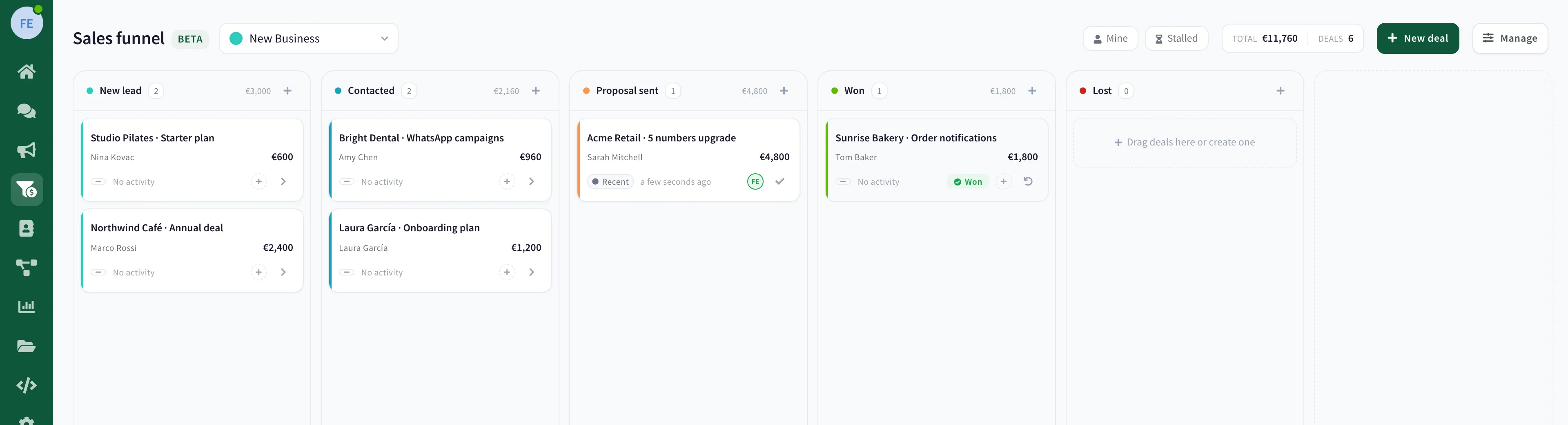
The board itself is easy. WaliChat gives you one out of the box, sitting on the same shared inbox your team already answers from, with five stages ready to go: New lead, Contacted, Negotiation, Won and Lost. Drag a card, the deal moves. That part takes a minute.
What takes judgement is deciding which columns your business actually has, and that decision is what makes the difference between a board your team keeps up to date and a board that is fiction by the second week. This guide is about that decision.
Rule one: name a stage after what the customer did
This is the single change that rescues most pipelines.
A stage called Interested cannot be verified. Two people looking at the same chat will disagree about it, and a week later nobody remembers what it meant. A stage called Quote sent either happened or it did not. So did Demo booked, Samples shipped, Contract sent and Waiting on their finance team.
The test is simple: could a colleague who has never read this conversation put the card in the right column just by scrolling the thread? If yes, the stage is an event. If no, it is a feeling, and feelings drift.
Feelings also hide bad news. A deal can sit in Interested for a month and still look alive. It cannot sit in Quote sent for a month and look like anything other than what it is.
Rule two: four to six columns, and be suspicious of nine
WaliChat allows up to twenty stages in a funnel. You almost certainly want between four and six.
The reason is not tidiness, it is arithmetic. Every extra column is another decision your team has to make on every deal, and the decisions get harder as the columns get finer. When the gap between two stages is small enough to argue about, people stop moving cards at all, and a board nobody moves is worse than no board because it looks like information.
If you find yourself wanting nine stages, one of two things is usually true:
- Two of them are the same stage with different amounts of hope. Contacted and Following up are one column. Merge them.
- You are running two different sales processes on one board. That is a real problem, and the answer is two funnels rather than nine columns. More on that below.
Start with the five defaults. Rename them to your own events. Add a sixth only when you catch yourself needing it twice in the same week.
Rule three: every funnel needs an end, and the end is not a feeling either
Each stage in WaliChat is one of three kinds: open, won or lost. A funnel always keeps at least one of each, which is the constraint that stops a board becoming a to-do list with no exit.
The kinds matter more than they look. Won and Lost are how the board can tell you anything about your business later, and a deal that is quietly abandoned in the third column tells you nothing at all. If a customer stops answering, the honest move is Lost, with a reason. You can reopen it the day they come back, and deleting a funnel later keeps its won and lost deals rather than taking your history with it.
The board defends this too: while you drag a card, the Won and Lost zones appear as targets. Closing a deal is a deliberate act, not something you do by dropping a card slightly too far to the right.
Rule four: a deadline per stage is what turns a board into a warning
This is the part most teams skip, and it is where the board starts earning its keep.
Give a stage a limit in days. When a card has sat there longer than that, it says so on its own face: Stalled. You are not remembering to check, and nobody is running a weekly report. The card tells you.
Set the limit to the honest answer to "how long is normal here?", not to the answer you wish were true:
| Stage | A reasonable limit | Why |
|---|---|---|
| New lead | 1 day | If a new enquiry is a day old and nobody has replied, that is the whole problem in one number |
| Quote sent | 3 to 5 days | Long enough for a customer to think, short enough to catch silence |
| Negotiation | 7 to 14 days | Real deals breathe here, so a tight limit just cries wolf |
| Waiting on the customer | 10 days | The stage exists to hold a deal, but not forever |
Separately, a deal whose conversation has had no activity for more than three days reads Cold. That is about the chat going quiet, not about the stage clock, and the two together tell you different things: Stalled means your process stopped, Cold means the customer did.
Two filters, Mine and Stalled, then cut the board down to your own deals or to the ones that stopped moving. Most days that second filter is the only view anyone needs.
Rule five: one funnel per sales process, not per product
The clearest sign you need a second funnel is that the stages stop making sense for half your deals.
New business and renewals are the usual pair. A new customer goes through discovery, a quote and a negotiation. A renewal goes through a reminder, a decision and an invoice. Forcing both onto one board gives you columns that half your cards skip, which is the fastest way to make a board unreadable.
Onboarding is often the third. It is not selling, but it is a sequence with stages and it is worth seeing.
A contact can sit in several funnels at the same time, each with its own stage, so the same customer can be a live renewal and a live upsell without the two interfering. What a contact cannot hold is two open deals in the same funnel, which keeps one customer to one card per board.
The chat panel in the inbox shows all of this next to the conversation: which funnels this contact is in, what each deal is worth, and a button to add them to another.
Rule six: let the assistant suggest, never decide
WaliChat watches the threads behind your open deals. Once a burst of messages settles down, it can pin a note to the card: either a proposal to advance the deal, or a flag that the thing looks shaky. The note says why, and quotes the line from the customer that prompted it.
Then it stops. Nothing changes column until a person says so.
Two of its limits should shape how you name your stages. It will not push a deal into a won or lost column at all, deliberately, because ending a deal is a judgement and a judgement should not ride on one sentence a customer happened to type. And it only ever looks at what you and the customer said to each other, not at the notes your team leaves internally.
Put those two together and your stage names are doing real work. Columns built on visible events give the assistant something to reason from. Columns built on how a rep feels give it nothing at all.
What working the board actually looks like
Once the stages are right, the routine is short.
Monday morning, filter to Stalled. Every card there is a decision: chase it, move it, or lose it honestly. Cards that are Cold but not Stalled are usually a nudge rather than a rethink.
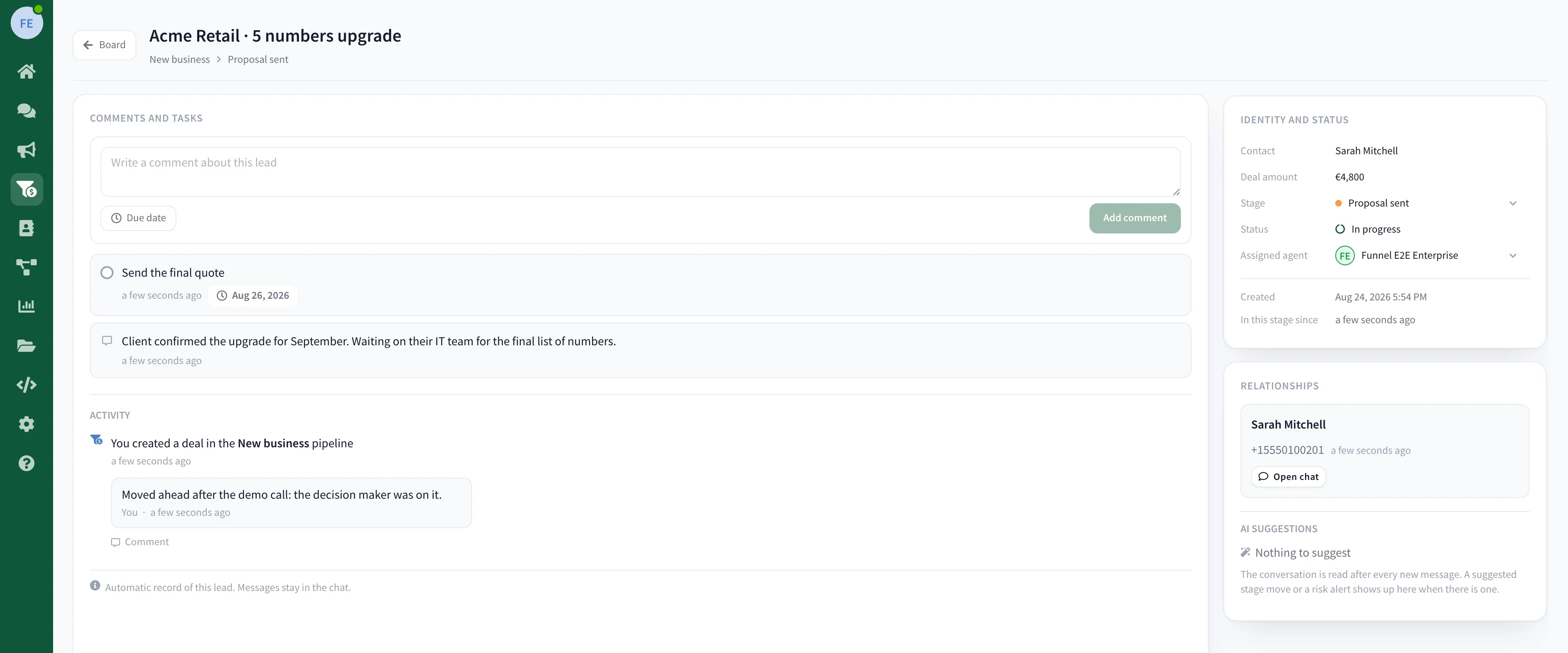
During the week, nobody visits the board much. The deal lives in the chat panel beside the conversation, so an agent moves the stage from where they were already working, and a deal can even start from a bare phone number and adopt the conversation as soon as that contact writes in.
Open a card and you get the deal its own page, at its own address, which is what lets somebody hand over a half-finished negotiation by pasting a link. That page keeps the things a chat thread never will: notes only your side reads, jobs with a date attached to them, and a log of every move the deal has made, naming whoever made it.
Frequently asked questions
Should I copy my old CRM's stages?
Only the ones that were events. Most CRM pipelines carry a couple of columns that exist because a report needed them, and those are the first to go stale on a board people actually use.
What if a deal skips a stage?
Let it. Skipping is information: if most deals jump straight from New lead to Negotiation, your second column is not a stage, it is a formality.
Can I change the stages later?
Yes, and you should expect to. The stage list is not a schema you have to get right on day one, it is a description of how you sell, and it will be wrong in small ways until you have watched real deals move through it.
How many funnels can I have?
One on Professional, three on Business and ten on Enterprise. The assistant's suggestions are part of the AI assistant, so they need Business or Enterprise.
Resources
- Sales funnels in WaliChat walks through the board, the deal record and the chat panel.
- Contacts CRM covers the customer file the deals sit on.
- Pricing lists what each plan includes.
Ready to put your pipeline on the inbox you already use?
The board is not a second system to keep in step. It reads the conversations already in your shared inbox, so there is nothing to import when you start and no spreadsheet that is stale by Thursday.
Start your free trial and rename those five columns to the events your business really has.